In this article
ChatGPT may not recommend your business because your website is difficult to retrieve, your content does not clearly match the customer’s question, or the answer selects other sources; a website audit can identify observable gaps, but it cannot reveal a provider’s private recommendation decisions.
That answer gives a business owner a useful starting point. Instead of assuming that an invisible penalty exists, separate the parts you can inspect from the parts you cannot control. Your public pages, crawler rules, descriptions, evidence, and customer experience are inspectable. A particular model’s internal selection process is not.
This guide explains how to investigate missing recommendations without pretending that every absence has the same cause. It distinguishes website readiness from actual visibility, uses published research carefully, and provides a diagnostic process you can hand to a developer or marketing team. The same process can inform investigations involving Claude, Gemini, and other search-enabled assistants, while allowing for differences between those services.
What does an AI recommendation actually mean?
An AI recommendation is an answer that presents your business as a relevant option for the user’s needs. A brand mention, a source citation, a navigational link, and a positive recommendation are different observations. Treating those observations as interchangeable creates confusing reports and encourages unnecessary website changes.
Consider an imaginary accounting firm called Harbor Ledger. An assistant might mention Harbor Ledger while discussing a competitor, link to its homepage when explicitly asked for the website, cite an article about bookkeeping, or recommend the firm for a local service. Those outcomes serve different intents. A homepage link supplied after a branded request does not establish that the firm is being discovered by new customers.
| Observation | What the observation establishes | What the observation does not establish |
|---|---|---|
| Brand name appears in an answer | The answer mentions the business | The answer endorses the business |
| A page receives a citation | The answer links to that source | The business receives meaningful traffic |
| A branded website request returns a link | The service can identify a destination | The business appears for unbranded buying questions |
| A business appears in a shortlist | The answer considers the business relevant in that response | The business will appear consistently |
| A visitor arrives from an assistant | A measurable referral occurred | The referral will become a customer |
Write down the outcome you want before diagnosing the website. A consultant seeking qualified inquiries needs a different measurement plan from a publisher seeking citations. A local retailer needs questions that reflect geography and availability. A software company needs questions that reflect features, integrations, pricing, and buying constraints.
Why the distinction matters: what published research shows
Pew Research Center analyzed browsing data from 900 U.S. adults and 68,879 unique Google searches in research published in July 2025. Traditional-result links received clicks on 8% of visits with an AI summary, compared with 15% of visits without one; summary source links received clicks on 1% of visits containing a summary. These are Google observations from that study, not ChatGPT conversion benchmarks. Read Pew’s methodology and findings.
The practical implication is a measurement decision: track discovery, citations, referrals, and business outcomes separately. A citation can exist without a visit. A visit can exist without a lead. The research does not establish how much traffic your business will gain or lose after changing a page.
Historical evidence should inform your questions rather than become a sales promise. When an agency presents an industry percentage as your likely growth rate, ask which population, time period, product, and outcome the percentage describes. A result about Google search behavior does not automatically describe recommendations in another assistant.
Reason 1: you tested the wrong question
A business can be absent from an irrelevant prompt while being discoverable for a useful one. “Best software” is a poor diagnostic query for a specialist scheduling application. “Scheduling software for a five-person mobile repair team that needs travel buffers” describes a customer problem that a specialist product could reasonably solve.
Start with the language customers use before they know your name. Read sales inquiries, support questions, intake forms, and search terms you already have permission to analyze. Remove private information. Group recurring needs by problem, buying stage, geography, budget, and constraints. Your first prompt set should reflect those needs rather than contain a list of flattering questions about your own brand.
Build a small intent map
An initial exercise can use 12 questions across four intent groups, with three questions in each group. Those numbers are a planning example, not a statistically validated sample size. The purpose is to prevent a single broad question from defining the investigation.
| Intent group | Example for an imaginary service business | Page that should help answer it |
|---|---|---|
| Problem discovery | How can a small retailer reduce bookkeeping errors? | A practical explanation of the problem |
| Service evaluation | Which bookkeeping services support inventory-heavy retailers? | A service page with scope and exclusions |
| Comparison | How does outsourced bookkeeping compare with hiring internally? | A balanced comparison page |
| Purchase preparation | What records should a retailer prepare before changing bookkeepers? | An onboarding or requirements guide |
Run the questions without inserting your brand. Then run a separate branded set. Branded checks reveal whether the business can be identified. Unbranded checks reveal whether it appears in the discovery situation you care about. Keep the two results apart when reporting progress.
Reason 2: the search system cannot retrieve the useful page
A page that opens in your browser may still present a challenge to automated retrieval. Authentication, intermittent errors, network restrictions, bot challenges, or an empty initial response can stop a system from reading the same information you see after the page finishes loading.
Inspect a representative service page, product page, and explanatory article. Check the response status, redirects, public HTML, and relevant directives. Record the exact URL that returned the content. A homepage that works does not establish that every important subpage works. A successful desktop session also does not establish that every crawler receives the same response.
Separate crawler roles before changing access rules
OpenAI documents OAI-SearchBot for search discovery, GPTBot for potential model-training use, and ChatGPT-User for certain user-directed requests. Search and training settings are independent; changing a training preference is not a universal search-visibility fix. Consult the current OpenAI crawler documentation before changing a policy.
The operational lesson is to name the system you are investigating. “AI bots are allowed” is too vague for a useful ticket. A better ticket identifies the relevant crawler, the path, the observed response, the access rule, and the person responsible for reviewing the change. Keep a record of the previous configuration so a mistaken rule can be reversed.
Do not disable important protections just to satisfy a test. A user-agent header can be imitated. Ask your infrastructure team to use documented verification methods and review the minimum access needed for public content. A configuration change should preserve account, checkout, administration, and other sensitive areas.
Reason 3: the page can be crawled but sends conflicting instructions
Retrieval and indexability are separate questions. A successful response can contain a directive that limits indexing or snippets. A canonical link can point to a different page. A staging template can accidentally carry production content with the wrong instructions. These are concrete configuration problems worth investigating before rewriting entire articles.
Google’s documentation distinguishes robots meta directives and HTTP header directives, including noindex, nosnippet, and X-Robots-Tag. Those controls have specific meanings within the documented system; they are not a way to command every AI service. Review the robots meta specifications.
Ask a developer to check instructions at both the document and server-response levels. A clean HTML template can coexist with an unexpected header added by a reverse proxy. An author may see the final page while missing that header entirely. Capture evidence from the actual published URL, not just a local preview or content-management draft.
A useful resolution includes a before-and-after record: the affected URL, the previous directive, the intended directive, and a fresh response after deployment. Avoid treating a configuration fix as proof of a future recommendation. The fix removes an observed obstacle; the downstream discovery outcome still needs separate observation.
Reason 4: your website never explains what your business does
Clear positioning gives a reader enough context to decide whether a business fits a need. A homepage that says “Transform your future with intelligent solutions” provides little information about the product, customer, service area, or outcome. The sentence may sound polished while leaving the central question unanswered.
Replace abstract claims with verifiable descriptions. An imaginary service provider could write: “Harbor Ledger provides monthly bookkeeping for independent retailers in Bristol, including inventory reconciliation and management reports.” That sentence identifies the business, service, audience, location, and scope. It does not require the reader to decode a slogan.
Check five concrete pieces of context
- Category: what kind of product or service the business offers.
- Audience: which customer situations the business serves.
- Scope: what the offer includes and excludes.
- Availability: geography, delivery method, or relevant operating constraints.
- Next step: how a suitable customer can verify fit or contact the business.
Use those details consistently across the homepage and relevant offer pages. Consistency does not mean repeating the same paragraph everywhere. A product page should explain the product in greater depth. A location page should provide meaningful local information. A comparison page should state its evaluation criteria rather than copy the homepage introduction.
Reason 5: the answer needs evidence your page does not provide
A recommendation often involves a claim about fit, capability, reliability, or expertise. A website that offers only adjectives gives a reader little to verify. Useful evidence can include documented specifications, named responsibilities, clear policies, worked examples, genuine customer accounts, and links to supporting material.
Choose evidence that fits the claim. A software integration claim needs documentation showing what the integration does. A service-area claim needs a clear description of availability. A performance claim needs a measurement method and relevant conditions. A general testimonial does not verify every technical statement on a product page.
Turn vague claims into inspectable information
| Vague claim | More useful evidence | Important limitation to disclose |
|---|---|---|
| Easy to set up | Setup steps and required permissions | Requirements vary by environment |
| Built for retailers | Retail workflows and supported inventory tasks | Unsupported cases and exclusions |
| Reliable reporting | Report definitions, sample fields, and update cadence | Data quality depends on inputs |
| Expert advice | Named team responsibilities and relevant experience | Experience is not a universal guarantee |
| Saves time | A documented customer example or transparent internal test | A single example is not an average result |
Never invent customers, reviews, awards, credentials, or studies to fill a credibility gap. A plainly described limitation is more useful than a fabricated proof point. If a claim cannot be supported, narrow the claim until the business can stand behind it.
Reason 6: the page answers a different question from the customer
A long page can still miss the decision a buyer needs to make. A service article may explain a concept thoroughly while never addressing suitability, price structure, required inputs, delivery constraints, or alternatives. The issue is relevance, not simply length.
Build a decision outline before adding paragraphs. For each target question, list the information a careful customer would need to choose responsibly. Mark which facts already exist on the page, which facts appear elsewhere, and which facts are missing. Link between related pages when the information belongs in a different place.
An imaginary scheduling application might need to explain appointment types, staff availability, travel buffers, calendar integrations, cancellation rules, and supported devices. It should also explain what it does not support. A buyer evaluating field-service software may rule out a product quickly if offline operation is unavailable. Hiding that limitation does not improve the quality of discovery.
Answer the main question in the first sentence of the relevant section. Follow the answer with conditions, evidence, examples, and exceptions. Clear headings help a reader find a topic, but headings cannot compensate for an answer that is absent from the text underneath them.
Reason 7: your information is fragmented across inconsistent pages
A business can make itself difficult to understand by using several product names, conflicting descriptions, old prices, and outdated contact details. A reader following multiple pages may find no reliable way to reconcile the differences. The same inconsistency can undermine a recommendation even when individual pages look polished.
Create a small entity inventory. Record the official business name, primary website, product names, service descriptions, contact methods, operating regions, and public profiles that genuinely belong to the company. Compare that inventory with the pages that customers and search systems can access.
Prioritize contradictions that affect a buying decision. An obsolete pricing page matters more than a minor punctuation difference. A service listed as available on one page and discontinued on another creates a practical problem. Resolve the underlying information, update relevant pages, and maintain redirects when an old URL has been replaced.
Structured data can describe accurate page information, but adding JSON-LD does not resolve contradictory visible copy. Treat the page and its machine-readable description as two representations of the same facts. If either representation changes, review the other one as part of the publishing process.
Reason 8: another source is a better fit for that answer
A missing recommendation can be a reasonable answer to the user’s constraints. A business may not operate in the requested location, offer the requested integration, support the requested budget, or provide enough evidence for the specific use case. Website changes should improve clarity about genuine fit rather than manufacture relevance.
When another business appears, inspect the answer and the linked material carefully. Identify the reason the answer gives for the recommendation. Look for concrete distinctions such as availability, documentation, specialization, or a direct explanation of the requested workflow. Separate those observations from assumptions about why an internal model made its choice.
A competitor comparison is most useful when it produces a specific editorial or product question. “Our integration page does not explain supported actions” is actionable. “The model likes our competitor more” is not. The first observation can lead to better documentation; the second encourages speculation.
Do not copy a competitor’s claims or create artificial third-party endorsements. Improve your own information and participate honestly in relevant public channels. Independent coverage is valuable when it reflects real work, useful participation, or verified experience. Bulk promotional comments and fabricated reviews create a different problem entirely.
Run a diagnosis that produces a useful backlog
A diagnostic workflow should end with decisions, owners, and evidence. A list of generic recommendations is difficult to implement because nobody knows which page to edit or how to confirm completion. Keep each finding small enough that a person can resolve it and verify the result.
Start with a representative sample
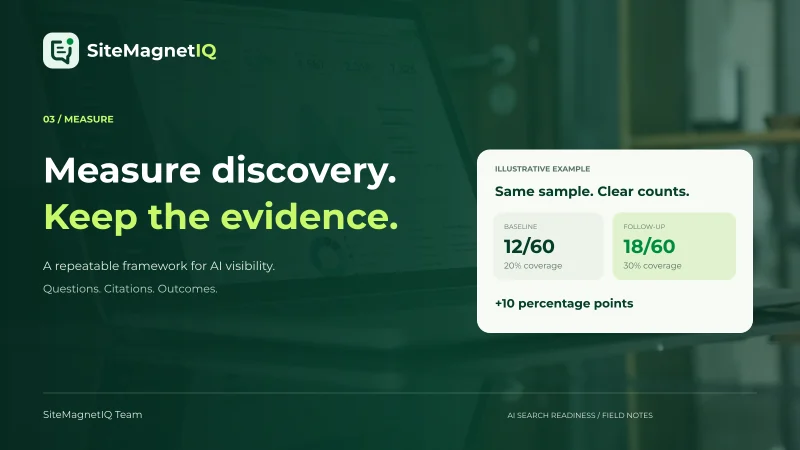
For an initial review, choose 10 important URLs: a homepage, several offer pages, useful explanatory content, and pages that answer common buying questions. Ten is a convenient starting sample, not a coverage guarantee. A large or highly varied site needs additional sampling by template and page type.
If four of those 10 pages lack a clear explanation of the offer, the observed sample gap is 40%. That calculation describes only the inspected sample. It does not establish that 40% of the entire website has the same problem, and it does not predict a 40% improvement in AI visibility after editing.
Write evidence-led tickets
Each ticket should include:
- The precise public URL and the date of inspection.
- The observed response, passage, directive, or missing explanation.
- The customer question affected by the gap.
- The proposed change and the person responsible.
- The check that will confirm the change is live.
- The separate visibility or business metric to observe later.
Prioritize access problems that prevent public content from being read, then resolve important contradictions and missing decision information. Cosmetic changes can support usability, but an attractive card does not substitute for a working page or an accurate explanation.
Where SiteMagnetIQ helps—and where it does not
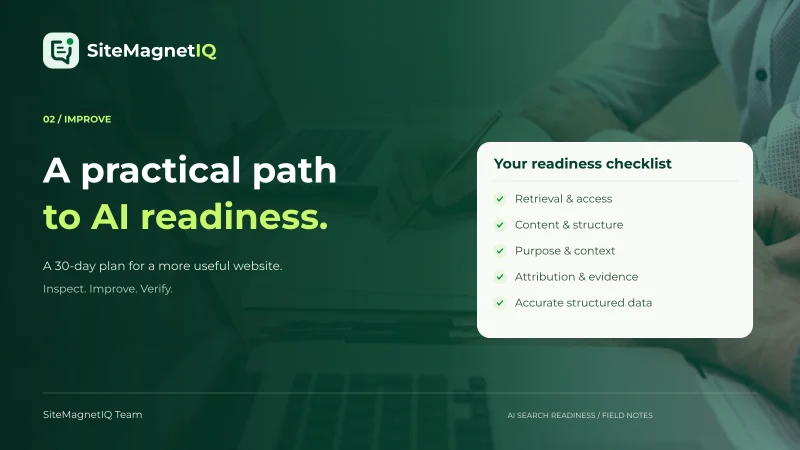
SiteMagnetIQ helps organize a website readiness investigation by checking public-page signals across retrieval access, content structure, purpose and context, attribution and evidence, and structured data. Findings include affected pages and recommended changes. Additional website audit categories provide context about SEO, conversion, trust, accessibility, ecommerce, and local business.
The current AI readiness audit does not query ChatGPT, Claude, or Gemini to measure mentions or citation share. A score summarizes observable website checks. A score does not explain a provider’s private ranking decisions, certify expertise, or guarantee that a business will appear in an answer.
Use an audit report as an implementation document. Share the affected URLs with a developer or content owner, agree on the changes, and rerun the website checks after deployment. Keep a separate log of representative questions and observed AI answers. Connecting those records helps the team distinguish a completed fix from an unverified business outcome.
For implementation details, continue with the 30-day AI search readiness checklist. For a repeatable observation process, read how to measure AI visibility without fooling yourself. The AI search readiness guide explains the product’s scope in more detail.
Frequently asked questions
Can I pay ChatGPT to recommend my business organically?
No. A website readiness audit cannot purchase an organic recommendation; a paid placement is a separate advertising outcome. Evaluate advertising products using their published terms and label paid results separately. SiteMagnetIQ does not create a special relationship with an AI provider.
Does allowing an AI crawler guarantee a recommendation?
Allowing a relevant crawler removes one possible access restriction. Access does not establish relevance, quality, selection, or future inclusion. Confirm that the public page is reachable, then investigate whether the page actually answers a customer’s question.
Should every page contain an FAQ section?
A page should contain FAQs when the questions help its audience. A checkout page, short product listing, and detailed explanatory article have different purposes. Adding the same generic FAQ block to every page can create repetition without adding useful information.
How soon should I expect a website change to affect an AI answer?
There is no universal timing promise for retrieval, indexing, source selection, or recommendation changes across services. Record deployment dates and repeat the same observation process over time. Verify that the website fix is live before interpreting later answers.
Is an AI readiness score the same as a ranking?
An AI readiness score summarizes a tool’s selected website checks. A ranking or recommendation is an observed result for a particular question in a particular service. The two measurements can inform each other, but they should never be presented as the same thing.
Sources and research notes
- Pew Research Center: Google users and AI summaries, July 2025. Historical U.S. browsing research; not a ChatGPT performance forecast.
- OpenAI: overview of crawlers. Primary documentation for search, training, and user-directed agent roles.
- Google Search Central: robots meta specifications. Primary documentation for Google’s page-level and HTTP-header controls.
The business names, sample sizes used for exercises, sample gap percentages, and diagnostic tables in this article are illustrative teaching examples. They are not customer results or a claim that SiteMagnetIQ has run a controlled visibility experiment. Provider documentation was checked when this article was published; operational teams should recheck it before changing production settings.

Written by SiteMagnetIQ Team
Practical website guidance with clear sources, explicit limits, and actionable next steps.
About our editorial approach ↗